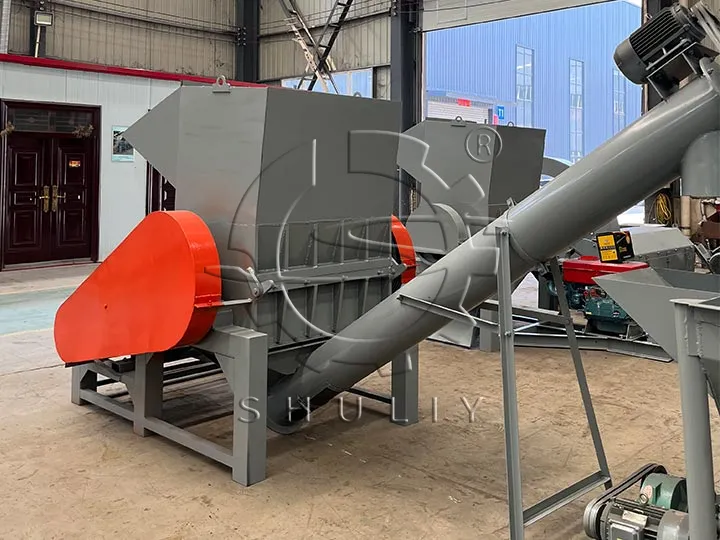
How Our Upgraded heavy-duty PP PE crusher Blades Boost Lifespan by 40-50%
Processing ductile polyolefins—such as high-density polyethylene (HDPE) hollow drums, agricultural LDPE film, and woven polypropylene (PP) bags—places distinct mechanical demands on cutting tools. While rigid plastics like PET shatter cleanly under impact, polyolefins have high tensile elongation and flexibility. When cutting blades begin to dull, these materials do not break; instead, they stretch, smear, and wedge themselves between the rotating knives and the chamber walls.
To solve this operational bottleneck, Shuliy Machinery phased out conventional manganese spring steel (65Mn) across our line. We now standard-equip our heavy-duty PP PE crusher machine with high-carbon, low-alloy 9CrSi tool steel blades.
While this metallurgical transition involves a slight price adjustment reflecting higher alloy and vacuum heat-treatment costs, the operational payoff is immediate: blade working life increases by 40% to 50%, routine maintenance intervals extend, and rotor blockages drop to near zero.
The Engineering of 9CrSi: High Chromium and Silicon Integration
The operational performance of a plastic crusher machine is governed by its ability to maintain a tight cutting clearance—typically 0.2mm to 0.3mm for thin films and 0.3mm to 0.5mm for rigid hollow containers.
9CrSi is a specialized alloy tool steel engineered specifically for low-speed cutting tools, circular shear blades, and heavy-duty industrial knives. Its chemical composition introduces two vital alloying elements that change how the blade behaves under load:
Chromium (Cr ~ 0.90% to 1.20%): Chromium significantly improves hardenability and forms hard, wear-resistant chromium carbides throughout the iron matrix. This molecular structure gives the blade superior resistance against abrasive silica dirt, preventing the edge from rounding off prematurely.
Silicon (Si ~ 0.60% to 0.90%): Silicon elevates the steel’s elastic limit and improves temper resistance. During high-speed continuous grinding, localized cutting temperatures at the blade tip can exceed 200°C. While standard 65Mn steel anneals and softens under this thermal friction, 9CrSi retains its structural hardness up to HRC 58–62.
Because the alloy resists thermal softening and abrasive wear, the cutting edge stays sharp up to 1.5 times longer. The result is a clean, scissor-like slice through thick-walled HDPE containers and stretch film alike.
Real-World Returns: The Factory-Floor Cost Calculation
A machine’s purchase price represents only a fraction of its total cost of ownership. The true operational expense of a granulator is dictated by knife maintenance, blade adjustments, and lost throughput.
Consider the baseline economics for a medium-scale washing plant operating an 800 kg/h line over a standard single-shift operational year:
| Operational Metric | Standard 65Mn Manganese Blades | Upgraded 9CrSi Alloy Blades | Direct Plant Advantage |
|---|---|---|---|
| Sharpening Frequency | Every 10 to 14 operational days | Every 20 to 28 operational days | 50% reduction in maintenance shutdowns |
| Edge Working Hardness | HRC 50–54 | HRC 58–62 (Vacuum Heat-Treated) | Resists abrasive wear from dirty ag-film |
| Material Behavior | Film stretches, wraps, and heats up | Clean, instantaneous scissor shear | Zero shaft wrapping; uniform regrind size |
| Motor Current Stability | Spikes by 25–35% as knives dull | Remains steady within baseline limits | Prevents breaker trips and saves electricity |
| Fines & Pull-Strands | High percentage of stringy, uncut film | Cleanly sliced flakes with minimal dust | Consistent bulk density for wash tanks |
When operators change or sharpen blades on a heavy-duty plastic crusher, the plant incurs two distinct costs: labor hours for removal, re-grinding, and dial-indicator clearance alignment, plus the commercial value of lost production capacity while the linha de pelotização is down.
By pushing the sharpening cycle out by 40% to 50%, a facility recovers hundreds of hours of production time annually. The initial price difference between 65Mn and 9CrSi hardware is typically recovered within the first two to three months of continuous operation.
Sustainable Reliability Over Cheap Hardware
Choosing the right heavy-duty PP PE crusher machine is an exercise in production continuity. Machines built with entry-grade 65Mn steel may present a lower initial capital expenditure, but they quickly generate hidden costs through frequent blade changes, motor strain, and line blockages.
By engineering our cutting assemblies with premium 9CrSi alloy tool steel, Shuliy Machinery provides operators with a durable, low-wear size-reduction system. This metallurgical upgrade maintains razor-sharp tolerances across grueling shifts, keeps motor amp draws flat, and ensures high-bulk-density flakes that flow smoothly into downstream washing and pelletizing lines.